



Dear Colleagues,
Welcome to the inaugural edition of The HELIOS Report. In each report, you will find an executive-level briefing on significant developments in higher education that demand leadership response. You can learn more about The HELIOS Report and how it was produced on the About page of www.heliosreport.com. We hope you find this informs your thinking and decision making as a higher ed leader. We look forward to your feedback.
- Ilene and Robert

Leadership in an era of program-level scrutiny
Increasingly, programs are expected to “pull their weight” individually. The developments discussed below illustrate several recent examples of that: states exploring three-year bachelor’s degrees, impending federal loan restructuring around questions of individual program value, new workforce Pell eligibility rules, a new “Credentials of Value” benchmark from Lumina Foundation, and a multidimensional credential-quality framework from Burning Glass. We read these as examples of incrementally tightening the link between specific programs and measurable economic outcomes. That puts higher education leaders into a position of deciding what to redesign, what to defend, what to subsidize, and what to close with integrity.
However, managing academic and co-curricular programs like an investment portfolio is unfamiliar and disorienting for many higher education leaders. Their professional identity may be tied to stewardship of a holistic curriculum whose value they are more accustomed to measuring in intellectual rather than financial terms. The news and reports discussed below are obviously not value neutral and, in our view, some of them are misguided. Therefore, leading through this shift requires the steadiness to hold academic integrity and performance accountability in the same conversation, to name trade-offs without panic, and to convert external pressure into disciplined decision making.
I. Developments
States allowing three-year bachelor’s degree proposals
Two more state systems are signaling renewed willingness to compress the bachelor’s degree timeline. North Dakota’s State Board of Higher Education approved several three-year pathways at public institutions. (Inside Higher Ed, Feb. 3, 2026). In Massachusetts, the Board of Higher Education voted to consider proposals for bachelor’s degrees requiring fewer than the standard 120 credits, described as “90-credit” degrees and framed as a three-year option. (Inside Higher Ed, Feb. 12, 2026). The reporting notes the regulation does not specify criteria, while stating proposals should respond to significant changes in society, demographics, technology, educational research, or expectations for postsecondary education. Supporters frame the move as affordability and speed to entering the workforce; critics frame it as weakening the degree by reducing learning that matters and by compressing electives and breadth.
ACE briefing on the U.S. Department of Education’s OBBB
The American Council of Education’s Government Relations team summarizes the work of two rulemaking committees implementing parts of the One Big Beautiful Bill Act (OBBB) at the Education Department: RISE (Reimagining and Improving Student Education) and AHEAD (Accountability in Higher Education and Access Through Demand-Driven Workforce Pell). RISE is directed to phase out graduate and professional PLUS loans, set new annual loan limits and lifetime borrowing caps, and simplify repayment plans. It tightens definitional machinery that matters for institutional oversight, including definitions for “expected time to credential,” “program length,” and how a student remains “in the same program of study” when switching majors. (ACE One Big Beautiful Bill Briefing (PDF), Feb. 1, 2026.)
New America on Workforce Pell implementation
An article from the think tank New America argues that decisions made before and beyond the pending implementation of Workforce Pell in July 2026 will shape which short-term programs gain access to Title IV funding and under what conditions. The article emphasizes that eligibility standards — such as program length, labor market alignment, quality assurance, and performance benchmarks — will determine how institutions design and oversee workforce credentials. It frames Workforce Pell as a structural shift that embeds federal definitions of value and demand directly into program approval and ongoing oversight. (New America, “Why Workforce Pell Implementation Matters Beyond July 2026,” Feb. 2026.)
Lumina’s “Credentials of Value” framework and benchmark
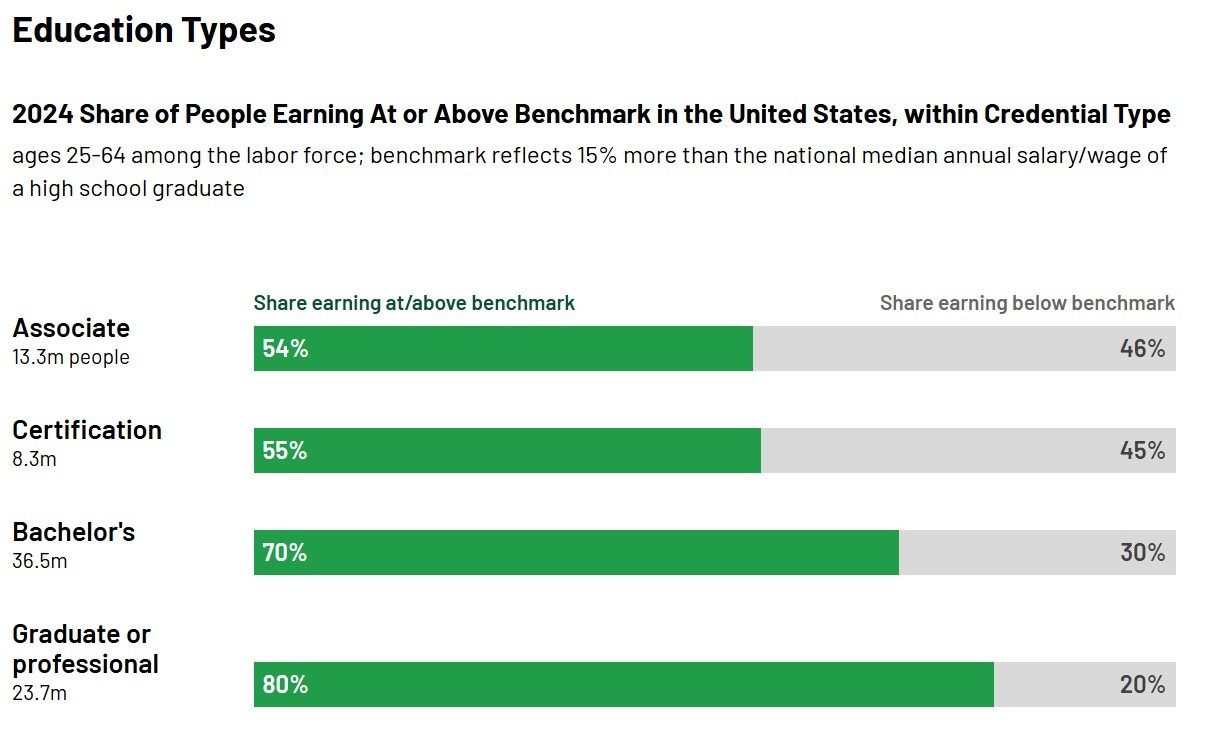
Lumina Foundation introduces a new “Credentials of Value” tool that measures the share of graduates ages 25–64 in the labor force who hold a post-high school degree or certification and earn at least 15% more than the median wage of a high school graduate. The methodology connects attainment to economic value, with a national goal of 75% by 2040. They publish an initial national baseline (43.6%) and explicitly frame the shift as “annual accountability,” tracking whether credentials translate into economic opportunity (Lumina Foundation’s Stronger Nation, Feb. 5, 2026):
Source: https://strongernation.luminafoundation.org/credentials-of-value
Burning Glass Institute: “Measuring What Matters”
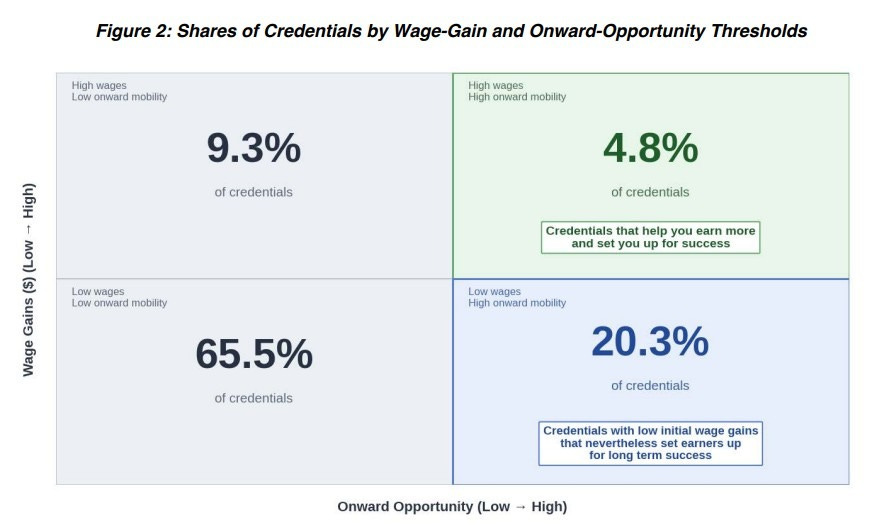
The workforce and education data analytics nonprofit Burning Glass Institute published a new report proposing a broader framework for evaluating non-degree credential quality beyond first-year wage gains. “Drawing on the Credential Value Index,” which links 23,000 credentials to career data from over 65 million workers, the report argues that wage-only accountability frameworks misclassify two-thirds of effective credentials. By incorporating career entry, field transition, and long-term mobility alongside immediate wage growth, they find that roughly one in three credentials generate measurable advancement, while still concluding that a large share of credentials provide minimal market value. It introduces a four-category typology: Launchpads, Promotion Catalysts, Lateral Moves, and Dead Ends (Measuring What Matters, Burning Glass Institute, Feb. 2026):
Source: https://www.burningglassinstitute.org/research/measuringwhatmatters
II. Interpretation — Portfolio orientation
These recent sources illustrate how external actors are tightening the link between educational offerings and outcome screens (while disagreeing about what filters and time horizons count.) That combination pushes provosts and deans away from stewardship of “the curriculum” and toward portfolio-oriented decision making at the program level. Program-level accountability itself is not new, but multiple actors are converging on compatible evaluation frameworks at the same time: federal financing rules, philanthropic benchmarking, labor market analytics, and state policy experimentation.
Lumina makes the portfolio approach explicit by defining value through an earnings screen and publishing a baseline for tracking and comparison. Lumina frames the tool as the start of a new era of accountability focused on whether credentials translate into opportunity. When a system adopts an earnings threshold tied to a national median, academic leaders must decide which credentials the institution can publicly stand behind under that definition, which credentials need redesign, which ones require clearer student guidance about likely economic outcomes, and which ones require either a defensible mission rationale or a clean exit.
Burning Glass accepts the accountability impulse but complicates the metric. It argues that wage-only evaluation produces a systematic blind spot because career pivots often require lateral moves or a temporary step back before gains show up. It demonstrates that some credentials function as launchpads into higher-mobility pathways rather than immediate wage maximizers. That critique does not reverse the portfolio shift but gives some nuance to what counts as valuable.
The trend to three-year degrees forces an explicit accounting of what the bachelor’s degree contains, what gets removed, and which learning claims the institution continues to make under compression. If this trend continues, the institution may not be able to rely on “the bachelor’s degree” as an undifferentiated unit to communicate. Institutions pursuing this will be making program-specific choices about which majors can survive compression without breaking academic integrity or licensure pathways.
ACE’s summary of impending student loan regulations, shows the portfolio orientation at work inside federal machinery: an environment that defines and polices program structure through eligibility rules, program definitions, and compliance obligations, while separating “accountability” and “Workforce Pell” into their own negotiated rulemaking lanes. Even when a rule targets financing, it still pushes institutions toward program-level clarity because definitions like “program length,” “expected time to credential,” and program-level consistency requirements create enforceable objects that do not care about campus narratives.
The Workforce Pell rules going into effect this year reinforce this same directional shift. Once short-term credentials gain Title IV eligibility under federally defined standards of labor-market alignment, duration, and performance, institutions must treat each eligible program as a discrete object subject to approval, monitoring, and potential loss of access to aid. An institution broadly supporting workforce preparation will not be sufficient. It must specify which certificates meet federal definitions of value and demand, which can sustain compliance over time, and which expose the institution to financial and reputational risk if performance falters.
In short: This selection of recent news stories and reports illustrate how higher ed is increasingly expected to attach funding, eligibility, and value metrics to program-level performance. If this continues, the academic catalog becomes a set of distinct profiles, each with a bright light on its own cost structure, outcome data, enrollment, and career outcomes.
III. Implications by stakeholder group
President and cabinet. The cabinet must treat “value” definitions as operating conditions that reshape academic decision making. Legislators and the benchmarking work of organizations like Lumina and Burning Glass will keep moving public expectations toward comparability, and compressed-degree and alternative credential proposals will keep asking whether the institution can defend what the degree includes. One of the cabinet’s jobs will be setting decision rights and guardrails: who decides thresholds, who decides exceptions, and who owns the public explanation when a program falls below a screen.
Provost, deans, and academic program design. Because portfolio frameworks force visibility into individual programs, Academic Affairs leadership will have to make intentional decisions which programs to subsidize. The Burning Glass report gives academic leaders a legitimate argument for longer time horizons and multidimensional outcomes, which can protect programs that serve mobility and field entry, while still allowing leaders to name “dead ends.” The work is codifying a decision process, a time window, and when mission rationale overrides an earnings screen.
Institutional research, analytics, and the registrar function. External frameworks are defining new metrics and asking for consistent application. Lumina’s tool sets a benchmark to compare to national medians and an age range; Burning Glass argues for trajectory analysis and multidimensional outcomes; ACE’s summary shows how federal definitions formalize “program length” and “expected time to credential” in ways that connect to catalogs and official publications. This will require data quality and category integrity to match internal program structures to external definitions.
Student affairs, advising, and career services. Portfolio logic changes advising obligations. Students will face, as Burning Glass puts it, more “high-stakes choices with limited, inconsistent information about what a credential actually signals to employers, what skills it confers, how it connects to real jobs, and what outcomes typically follow.” Advisors and career counselors need a message that does not pretend certainty. They need clear institutional guidance on which pathways the institution actively recommends, which ones it offers with explicit cautions, and which ones it is redesigning or phasing out.
Finance and budget leadership. Three-year degree proposals turn time-to-degree into a revenue and cost question, because credit volume and delivery design drive both pricing assumptions and instructional cost. Lumina’s benchmark logic and public accountability frame increase the likelihood that funders and state actors will pressure institutions to concentrate investment in “value-clearing” pathways. Finance leaders will need a shared operating picture with the provost so that budget rules do not silently punish the very redesign work that the external environment is demanding.
Faculty development, centers for teaching and learning, and program design. Portfolio orientation potentially influences syllabi, assignments, and curricular maps. If programs are judged on wage, mobility, and completion signals, then faculty development may emerge that helps departments articulate how learning outcomes connect to occupational pathways without collapsing into narrow training. Centers for teaching and learning will need to support faculty in mapping competencies, sequencing skill development across courses, and documenting where students practice applied work. Program review processes will need to ask not only whether learning goals are coherent, but whether graduates can demonstrate capabilities that align with labor-market entry and advancement. To resist pressure to instrumentalize the curriculum, programs need to be able to make visible how disciplinary depth translates into durable capability.
Marketing and communications. As external actors narrow value into measurable outcomes, institutions will need to articulate what a degree is for without leaning on abstraction. Portfolio logic forces leaders to name the mission precisely. If a program does not clear a short-term earnings screen but cultivates liberal arts skills, civic leadership, cultural stewardship, scientific inquiry, or long-term mobility, leaders must be able to state that case with evidence and discipline. Presidents, provosts, and faculty leaders will need language that connects disciplinary depth to durable capability, democratic participation, and adaptive learning, and they will need to explain why some commitments merit support even when immediate market signals are weak.
IV. The leadership demand
The shift to a portfolio orientation is a mission-performance opportunity if leaders handle it with steadiness. If portfolio management expectations keep growing, leaders still control how it lands on faculty, advisors, student support professionals, and other colleagues and how it reshapes institutional identity.
A deficit posture treats external screens as an indictment and treats every program review as a threat. An assets-based posture treats the same environment as permission to do overdue redesign work with more context and clarity. Burning Glass gives leaders language to defend programs that create long-run mobility and field entry, while still naming programs that fail students on both wages and mobility. Lumina gives leaders a public baseline and a goal structure that makes it easier to focus attention and resources. Three-year degrees give leaders an incentive to clarify what the bachelor’s degree means in different majors, rather than defending a single undifferentiated degree story. The three-year degree trend, whatever its practical merits, can also be read as a signal that the public is hungry for innovation and for the opportunities that higher education promises.
This will also bring up questions about professional identity. Faculty and academic leaders who see themselves as stewards of a shared intellectual project will experience portfolio logic as a value conflict.
In short: Leaders can set a decision-making practice that keeps academic integrity explicit: Define non-negotiables for learning, define acceptable evidence for outcomes, and define the conditions under which mission rationale can justify investment even when an earnings screen looks weak.
V. Strategic questions for the cabinet and board
What institutional capabilities must improve if program-level accountability expands? Data integration, labor-market analytics, program cost modeling, and advising capacity may determine whether portfolio management becomes disciplined leadership or administrative chaos.
Which programs require explicit mission defense rather than economic justification? If a program does not clear emerging economic benchmarks, can the institution clearly articulate the civic, intellectual, or cultural purpose that justifies continued investment?
Which metrics will the institution treat as informative rather than determinative? External benchmarks, employer data, and federal eligibility standards will shape the environment, but leadership must decide which ones actually govern internal decision making.
What time horizon will the institution treat as legitimate evidence of value? If external actors emphasize first-year wages while the institution believes value appears through long-run mobility or graduate study, where will leadership draw the line between short-term metrics and longer-term outcomes?
When will the institution stop offering pathways that produce minimal short-term value for students? Who has the authority to close a program, and what processes protect legitimacy when that moment arrives? Clear decision rights and transparent processes protect the institution and demonstrate respect for faculty and staff.
What story will the institution tell when a program is redesigned or discontinued? Leaders should determine whether the narrative emphasizes stewardship of student opportunity, institutional sustainability, or mission clarity.
VI. Postscript — Late developments
As this edition of The HELIOS Report neared the final stages of editing, we encountered additional relevant news on this theme. We encourage you to review the sources below about a growing list of states tying program-level defunding decisions to federal analysis of “low-earning” degrees, and we invite you to add resources in the comments you have come across to continue the conversation with your colleagues.
Three Competing Ways States Are Defining the “Value” of Higher Education, Phil Hill & Associates, February 2, 2026
Indiana governor signs law to cut ‘low earning’ college degrees, Higher Ed Dive, March 6, 2026
Missouri Senate looks at funding cuts for ‘low-earning’ college degrees, Missouri Independent, February 25, 2026
The HELIOS Report is a joint project of Ilene Crawford Consulting and McGuire Editorial & Consulting. It is developed with HELIOS — Higher Education Leadership Intelligence Orientation System, a proprietary AI-assisted intelligence system that applies a defined set of analytical frameworks and strategic filters to generate usable insights for leaders in higher education, workforce development, and education technology. Learn more, provide feedback, and join the email list for future reports at www.heliosreport.com.